
Living with companion animals
About Companion Care Desk
About Companion Care Desk
Companion Care Desk is an independent new publication from SiteLift Media about living with companion animals. At companioncaredesk.com, we publish guides for people who share their homes with cats, dogs, birds and pet reptiles. We start with the animal in front of you, the space it uses and its daily rhythm, whether that means a cat’s afternoon visits to the windowsill or a dog’s habit of waiting by the door after breakfast.
The site is for people getting to know an animal as well as those who have lived with one for years. You might be working out where a recently arrived cat spends its evenings, or trying to describe how a familiar dog’s weekday walks differ from its weekend walks. You do not need a dedicated pet room or an elaborate record system to make use of the guides.
We focus on questions you can put into ordinary words. Which perch does the bird use while people are in the room? Does the dog pick up the same toy before and after a walk? Are the reptile’s enclosure readings taken in the same place each time? Those details help define the question before you decide which guide to read.
Cats and dogs
Our cat and dog guides cover feeding, walks, play and the household routines around them. A feeding routine includes more than the time written on a schedule. The guide you need might be the one that helps you describe who sets out each bowl, which room the bowls are in and what usually happens there while the animals eat.
Walks and play can be described with the same attention to detail. A dog may spend much of a short outing sniffing along one stretch of pavement, while a longer outing follows a different route. A cat may bat at a toy on the rug but ignore it on the sofa. Noting the activity and the setting gives you more information than marking both occasions as exercise or play.
A brief record can give an unfamiliar behavior some context without assigning it a cause. If the cat leaves the room halfway through its usual evening play, a note might include the time, the toy and who was in the room. If two people share dog walks, it can be useful to distinguish the person who took the dog out from the route they took.
Birds and shared rooms
Our bird coverage begins with the room as it is used, not with a perch in isolation. A room description can include where the windows and doors are, which side of the room people sit on and where the bird actually travels in flight. It can also distinguish the perch the bird uses during a quiet morning from the one it visits when the room is occupied.
Social time is another part of the daily routine worth describing. A bird may spend part of the day near someone who is reading and another part interacting with people who are talking. Those are different observations, even if both happen in the same room. Our guides use examples like these to make terms such as company and interaction more specific.
Enrichment questions depend on the species and on what the individual bird does with an object. A guide might distinguish a bird that approaches an item, one that picks at it and one that spends time nearby without touching it. When you return to your notes, those descriptions tell you more than a single mark for whether the item was used.
Pet reptiles and enclosure records
We cover reptile enclosures as spaces with conditions that can be recorded and compared. Temperature gradients, humidity, lighting and shelter belong in a species-specific discussion. A guide can help you identify the question to take to a reference for the species you keep, rather than treating an enclosure for a leopard gecko and one for a crested gecko as interchangeable.
Location and timing matter when you describe a reading. A temperature recorded near one end of an enclosure is not a description of the whole enclosure, and a humidity reading without a time leaves out part of the observation. An enclosure record can distinguish readings at different locations from changes at the same location over the course of a day.
We also distinguish what is in the enclosure from what you have seen the animal use. A list might include two shelters, while an observation records which one the reptile occupied when you looked. Likewise, the lighting schedule and the time an animal was visible are two separate details. Keeping them separate makes the entry easier to interpret when you read it later.
The calico at the desk
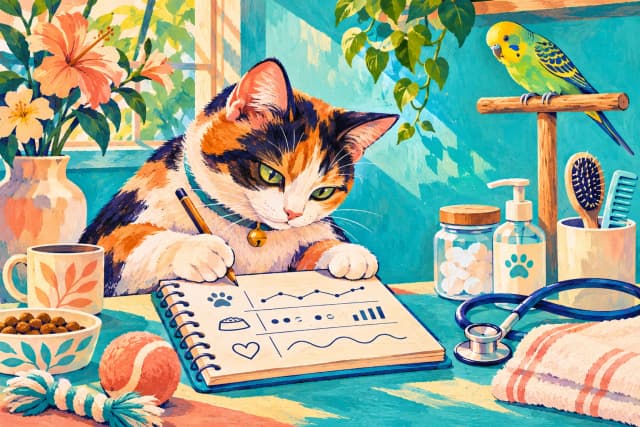
Our mascot is an illustration of a calico cat keeping notes at a turquoise desk. The cat represents the companion animal whose day the guide is about, and the notebook represents the reader’s observations. A page of those notes could be as ordinary as a record of which room the cat chose for a nap while the living room was busy.
The mascot is a cat, but the same attention belongs in a guide about a dog’s stops on a familiar walk or a bird’s use of two perches. The point of recording the stops or the perch visits is to preserve what happened. It is not to decide, from that observation alone, why the animal did it.
You do not need to keep notes at a desk, or even on paper. A short entry on your phone may be enough to record that the dog carried a toy into the hall after dinner. For an enclosure reading, the useful details may be the measurement, time and location. The amount you write can vary with the question.
Finding a guide
Use Around the home to browse the site and Care Guides to find the guide archive. Start with the animal you live with and the question you have now. If you are looking for material about a bird’s perch use, for example, the discussion of room layout is more relevant than a general article about buying pet enrichment toys.
The publication includes original longer guides for subjects that need several connected examples. A guide about a dog’s routine can look at what happens before the walk, how the outing is described and what the dog typically does on returning home. You can read the whole guide for context or return to the part about the stage you are observing.
The site has public RSS and Atom feeds for readers who use a feed reader. You can add the format your reader supports and look through new entries there. If you are looking for an existing piece on cat play or reptile enclosure records rather than browsing new entries, start with the Care Guides archive.
How the publication is made
Companion Care Desk uses AI assistance in research, drafting and illustration. That assistance is part of how the publication is produced, including its longer guides. An illustrated bird room is an example of a layout, not documentation of a particular household. Likewise, an example of a dog’s walk record shows what an entry can contain rather than reporting a test with a dog.
The guides are written for general reading about home routines and observation. A record of which bowl a cat approached can describe what you saw, but the guide does not use that observation to assess the cat’s health. A reptile article can explain what a recorded value refers to without interpreting the conditions of an individual animal’s enclosure.
Some pages may include affiliate links, including links related to pet enrichment toys. Affiliate disclosures explain the commercial relationship where it applies. A mention of a toy in a guide about play does not indicate that Companion Care Desk tested it. Descriptions of how a cat might bat at an object or how a dog might carry one are examples of behavior, not product test results.
Questions and corrections
Use Contact to flag something that may be inaccurate or unclear. The page title or address and the relevant passage help identify the issue. If a bird guide uses a broad term where it should distinguish between species, for instance, include the wording you noticed and explain which distinction you think the passage leaves out.
Corrections can also concern the details of an example. If an enclosure article switches between two measurement locations without making the change clear, identify the sentences that are hard to reconcile. If a cat guide uses the same term for setting down food and for the animal actually eating it, point out where the difference matters to the record being discussed.
If you are visiting for the first time, try looking through Care Guides with one question in mind. You might want a clearer way to describe where your bird spends time while the family is in the room, or a way to compare your dog’s afternoon outings. Start with the guide that fits that question and use the examples that match what you observe at home.
Read our editorial standards or send a question or correction.