
1. Give each animal a record of its own
Imagine it’s 8 p.m. in a household with a dog, two cats, a cockatiel and a bearded dragon. The dog’s usual walk was skipped. There’s a new clump in a shared litter box, but nobody saw which cat used it. The cockatiel is quieter than usual while the family clears dinner. The dragon’s enclosure display has gone blank. A single calendar entry that says “evening pet care incomplete” would hide four different events: a missed task, an observation that can’t be assigned to an individual, a change in behavior and an equipment failure. Each belongs in the record, but none means the same thing.
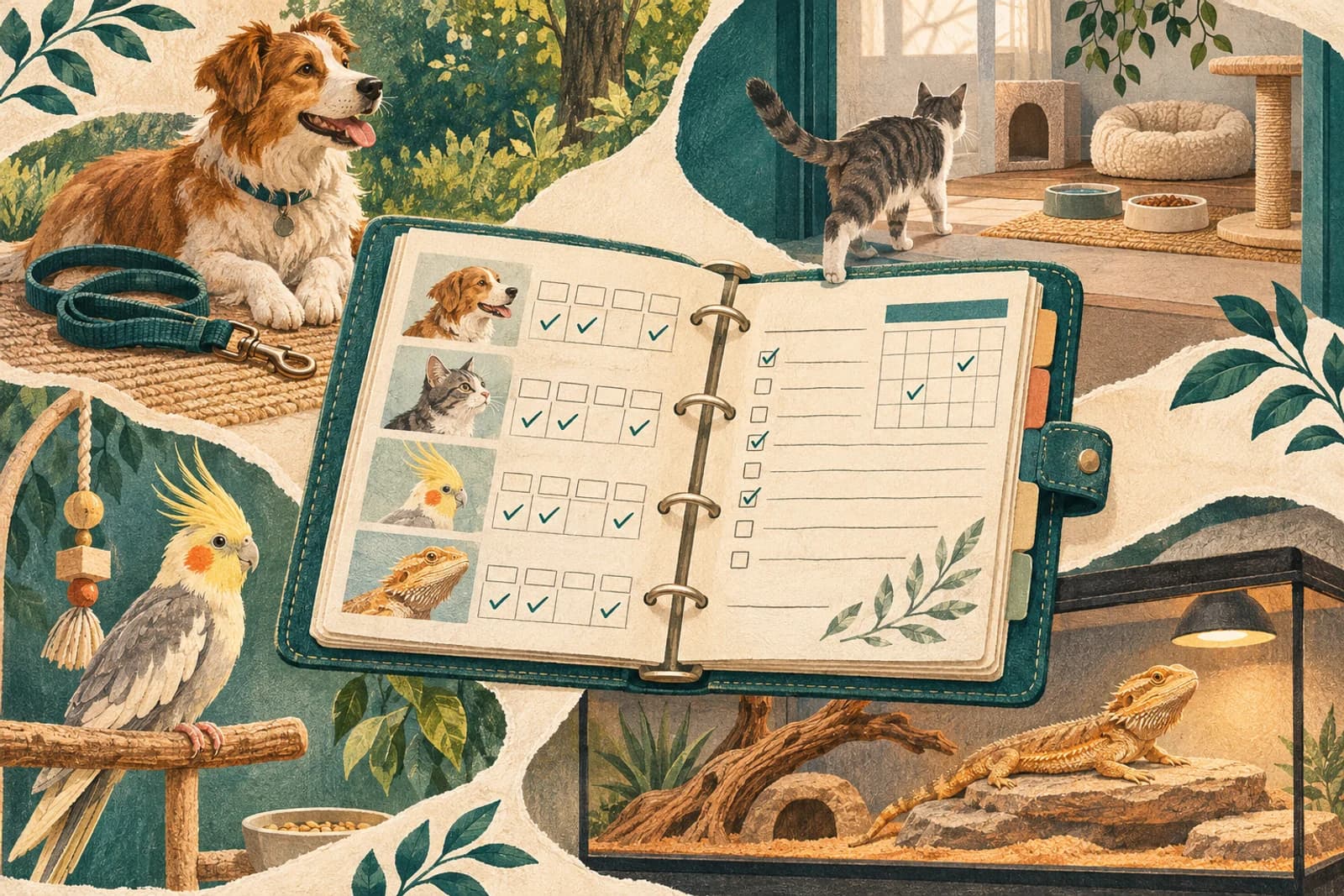
A shared calendar is useful for telling everyone who is on duty. It’s less useful for describing what usually happens with one animal. Start with a separate profile for each pet, including each cat in a household that shares supplies. List the animal’s name, exact species, age or estimated age, life stage and the names of the people who normally provide care. Include the regular veterinary contact and the location of the current clinic instructions. “Dated instructions in the front pocket of the blue binder” is more useful than “ask Sam,” especially if Sam is unreachable. Mark clinic instructions with their date so a substitute doesn’t mistake an older printout for the current plan.
Give that profile a short description of the animal’s usual pattern. The canine life-stage guidelines from the American Animal Hospital Association emphasize owners’ observations of activity and mobility at home. The joint AAHA and American Association of Feline Practitioners guidelines organize preventive discussions around life-stage concerns including nutrition, weight, behavior and elimination. A useful baseline translates those broad categories into things a caregiver can recognize: “Usually follows me to the back door when I pick up the leash” is more informative than “active.” Add the circumstances that make the description meaningful. An animal’s usual behavior when the house is quiet may not be what a visitor sees.
The second layer is a dated log of tasks and exceptions. A usable entry answers: Which animal? What time? Who was there? What was done or directly observed? If there’s a number, what are the units? How certain is the observer? Use plain labels such as “seen directly,” “reported by another caregiver” or “not observed.” A completion check is enough for many ordinary tasks; save the longer note for a change, uncertainty or missed task. If the entry is written later, note when the event happened and mark an approximate time as approximate. That keeps a bedtime entry from looking as though everything in it happened at bedtime.
In the hypothetical household, the dog’s log might say, “Milo, 7 p.m., Jess: scheduled walk not done; I got home after the usual time.” That establishes what happened to the plan, not whether Milo was unwilling to go. The cat observation can live in a shared litter-box note without being assigned to either cat: “7:10 p.m., Jess: one new clump in hall box; cat not seen.” Don’t copy it into both individual logs as if each cat was observed urinating. If the veterinarian later asks about one cat, the difference between “I didn’t see” and “I saw that it didn’t happen” matters.
For the cockatiel, “7:15 to 7:30 p.m., Jess: no usual whistles while I cleared dinner” gives a comparison another regular caregiver can understand. A substitute who has never heard the bird at that hour could record what they heard without judging whether it was typical. The Association of Avian Veterinarians identifies changes in vocalization, eating and droppings as possible early signs of illness. A note about quiet behavior is therefore worth taking seriously, but it doesn’t tell you why the bird was quiet. The record is not a reason to wait for another entry before contacting the avian clinic about a concerning change.
For the dragon, “7:20 p.m., Jess: basking-area monitor screen blank; temperature unknown at that time” preserves the distinction between the instrument and the enclosure. A blank screen does not establish that the enclosure is cold, and yesterday’s reading is not a substitute for today’s missing value. The Merck Veterinary Manual describes a heat gradient as a way to give a reptile a choice of conditions. That’s why a valid reading needs a location as well as a unit: a measurement from one end doesn’t describe the other. Keep an equipment exception visible even if nobody noticed a change in the animal.
At a handoff, have the incoming caregiver read back what is still open. In this example, the dog’s walk is confirmed missed, the cat observation remains unassigned, the bird’s behavior differs from one caregiver’s baseline, and the dragon’s reading is unavailable. None should be converted to a check mark just to clear the calendar. A veterinarian can use the distinction to ask better follow-up questions, and the next caregiver can see what was actually observed. The record helps both conversations; it cannot determine what condition, if any, an animal has.
Sources for this section: 2019 AAHA Canine Life Stage Guidelines; 2021 AAHA/AAFP Feline Life Stage Guidelines; Signs of Illness in Companion Birds; Management and Husbandry of Reptiles.
2. Put the emergency instructions where everyone can find them
Put the emergency card at the front of the care record, not behind the daily notes. Keep a copy where a sitter can find it without unlocking someone else’s phone. For each animal, give the regular clinic’s name and number, the after-hours destination with its phone number and address, and a backup service. Write the exact species next to each animal’s name and note which service has confirmed it accepts that species. Include where the appropriate carrier is stored, such as “cockatiel transport enclosure on the lower shelf in the hall closet,” rather than just “carrier in closet” when there are several.
Verify coverage by calling ahead while everyone is well. A nearby emergency hospital may see dogs and cats but not birds or reptiles, or it may accept an exotic species only when certain staff are on duty. Ask about your specific animal, when the service can receive it and where the clinic directs patients if it cannot. Date the confirmation and recheck before a sitter takes over if the information may have changed. The card should name the backup, not leave the sitter to work down a web search. If an emergency occurs, call the hospital so the staff can prepare, as the American Veterinary Medical Association advises.
Make the distinction between “call now” and “ask at a routine visit” easy to see. Labored breathing, collapse or unresponsiveness belong on the immediate-contact list. A question about where to put a healthy cat’s second litter box or how to document an otherwise uneventful walk can wait for a planned conversation. But routine does not mean everything short of collapse: a new or concerning change deserves a call to ask about timing, not an automatic place on next month’s agenda. Warning signs on the card are examples, not a checklist an animal must complete before anyone calls.
For a cat, **repeated attempts to urinate with little or no output require immediate veterinary attention**. The Cornell Feline Health Center explains that different urinary problems can look similar at home and that this pattern can indicate an obstruction. Don’t wait to see a new clump or assume the cat is trying to pass stool. In a hypothetical call, a caregiver might say, “I saw Juniper crouch and strain in the box three times in the last 20 minutes. I saw only a few drops. I don’t know when she last passed a normal amount.” That last sentence is useful information, not a gap to fill before calling.
For a companion bird, inability to perch, breathing difficulty or blood loss calls for veterinary help at once, according to the Association of Avian Veterinarians. UC Davis veterinary hospital guidance also lists severe weakness and staying at the bottom of the cage without perching among emergency presentations. Picture a cockatiel that cannot stay on its perch and is now on the cage floor. Tell the receiving clinic exactly what the bird is doing. Neither a normal weight from last week nor the absence of a video makes the situation less urgent. Don’t try to get the bird back onto a perch to confirm what you saw.
For a reptile, call immediately about open-mouth breathing or any sign that breathing takes more effort than usual. UC Davis lists open-mouth breathing among reptile emergency warning signs. Central bearded dragons sometimes briefly hold their mouths open while basking, but location alone cannot tell you whether an animal is struggling to breathe. If you’re unsure what you’re seeing, call immediately rather than watching for another episode or comparing it with videos. Report where it happened and what you saw, such as “mouth open and visibly working to breathe in the cool retreat, not at the usual basking spot.”
Give the clinic the facts that help it receive the right patient: the species, what is happening now, when you first noticed it, whether the animal is responsive if you already know, and any relevant exposure or recent event you directly observed. Then ask whether the service can receive the animal now and what to do about getting there. For example: “I have a bearded dragon with new labored breathing. I first saw it five minutes ago. Can you receive a bearded dragon now? If not, where should I call?” Follow the veterinary team’s transport instructions rather than borrowing first-aid techniques from a different species.
Test the card by asking a backup caregiver to locate the right number and carrier without prompting. If the after-hours line goes unanswered, the backup number should be right beside it. Put the call instructions above any reminder to bring records. A photo already on your phone or a recent reading already in the log may help the clinician, but no one should stop to take a photograph, weigh the animal, collect a new reading or search online before seeking help. The card’s job is to get the animal to veterinary care, not to produce a complete account before anyone leaves home.
Sources for this section: Pet First Aid; Feline Lower Urinary Tract Disease; Signs of Illness in Companion Birds; New Emergency Service Established for Companion Exotic Pets; Hypoxia progressively lowers thermal gaping thresholds in bearded dragons, Pogona vitticeps.
3. Dogs: Write down the walk the dog actually took
A dog’s daily plan can put meals, bathroom opportunities, activity, mental stimulation and rest in an order that fits the household. Give the person on duty enough detail to carry it out, but keep the schedule distinct from what actually happened. A reminder that says “afternoon walk” can stay the same even when the route, pace or reason for coming home changes. The American Animal Hospital Association’s canine life-stage guidelines emphasize matching exercise and mental stimulation to the dog’s age, breed and temperament. A walk log is useful because it describes the activity this dog took part in, not because it measures progress toward a universal number of minutes.
Take a hypothetical puppy learning the layout and routine of a new home. The plan says to offer a bathroom outing after breakfast, make time for a simple activity while the puppy is awake and leave room to settle and rest. The morning entry reads, “7:25 a.m., back door to yard, cool and dry; walked slowly while sniffing, paused at the gate, came inside with me. Later looked for a toy I hid in the living room, then settled on the mat.” That describes the outing and what the puppy did indoors. It doesn’t turn the gate pause into a problem or make the puppy’s schedule a recommendation for another dog.
Now consider a hypothetical senior dog whose familiar loop starts down three porch steps and comes home through a level side gate. On Monday, the caregiver writes, “8:05 a.m., dry pavement, usual pace to the corner; returned through side gate.” On Wednesday: “8:10 a.m., dry pavement; stopped at the top of the porch steps, then walked toward the side gate when I opened it. Walked to the first driveway and stopped; we turned back.” Record both the transition at home and the distance reached on the street. Writing only “short walk” would erase where the dog stopped and which parts of the usual outing still took place.
Weather, traffic, footing and the caregiver’s choices can all change what a walk entry means. “Turned back at the first driveway because I heard thunder; dog had been walking at usual pace” describes a human decision. “Stopped at the first driveway on three dry mornings; each time I turned back with him” describes a repeatable observation about the dog’s route. Neither note explains why the dog behaved as it did. The repeated change is worth raising with the clinic rather than asking the dog to finish the loop to see whether it happens again. If you know who ended the outing, include that detail instead of using “wouldn’t walk” for both situations.
Look at the route from the dog’s bed to the sidewalk, not just the stretch tracked on a walk. Sketch the floor and mark the smooth tile in the entry, the edge of a runner, the threshold and the porch steps. A caregiver might note, “Shortened stride crossing the tile after getting up, then walked at the usual pace on the runner.” Marking where that happened gives the veterinarian something more concrete to discuss than “slowing down.” AAHA’s canine guidelines call for attention to owner observations of mobility at home and potential environmental adaptations for senior dogs. Ask if a different exit or a change in footing would be appropriate for this dog.
Record the rest of the day well enough to show what changed when an outing didn’t happen. If a storm cut the walk short, the note can say the dog still had a later bathroom opportunity and spent part of the evening looking for a familiar toy indoors. That doesn’t make the toy search equivalent to the walk. It tells another caregiver what was offered and how the dog engaged. Likewise, “settled in the usual spot after coming home” is more useful than assigning a general energy score with no reference point. When two people share care, agree on the landmarks they will use so “short loop” means the same route to both.
Bring a few representative entries to the clinic rather than making the veterinarian reconstruct the change from a month of check marks. Useful questions include: “Given where she’s stopping, what activity is appropriate until you’ve assessed her?” “Would you suggest changing the route, the footing at the door or how we handle the steps?” and “What changes during or after activity should prompt a call?” Include the distinction between a dog who pauses and then continues at a familiar pace, and one who repeatedly stops where she used to keep going. That is a description the clinician can work with, not a diagnosis or permission to increase the dog’s activity.
Some changes don’t belong in a wait-and-discuss category at all. Heavy panting with weakness or confusion after heat exposure can be a sign of heatstroke and requires emergency veterinary care. The American Veterinary Medical Association advises starting to cool the dog right away and getting to a veterinary hospital as soon as possible. Call the hospital to alert staff and ask for cooling and transport guidance. If you already know when the exposure occurred and when the signs began, tell the clinic, but don’t spend time reconstructing the route or waiting to see whether the dog recovers.
Sources for this section: 2019 AAHA Canine Life Stage Guidelines; Pet First Aid.
4. Dogs: Turn meals and bathroom breaks into an individual history
At Milo’s next wellness visit, “one scoop twice a day” could describe the household plan without describing a single meal he ate. The scoop might be filled differently by two people, a serving might be left unfinished, or a training session might add food that never entered the bowl. The American Animal Hospital Association’s canine life-stage guidelines treat nutrition, medications and supplements as relevant parts of a preventive history. To make that history useful, give each meal separate fields for the planned serving, what went into the bowl and what was left when the bowl was picked up. Record extras separately.
A hypothetical Tuesday entry might read: “7:15 a.m., Jess, Milo’s usual dry food. Planned 90 g; offered 90 g; 20 g left when I picked up the bowl at 7:40. I watched him eat and no other pet reached the bowl.” In the evening, the record might say, “Planned 90 g; offered 70 g because that was all that remained in the bag; nothing left when checked.” Those amounts describe an example, not a feeding target. If nobody watched the evening meal and another dog could have reached it, write “bowl empty at pickup, eater not confirmed,” rather than counting the entire serving as Milo’s intake.
Put food given away from the bowl in the same day’s record. “12:30 p.m., Lee: four pieces of the usual training treat during practice; one chew offered at 4 p.m., about half left when I took it away” gives the clinic more to work with than “some snacks.” If Lee remembers giving the treats but not their number, the log should say so. Use the exact product name when it is known and distinguish grams, pieces and fractions of a chew. If the household uses a scoop, specify its size and whether the serving is level or heaped rather than letting “one scoop” stand in for a measured weight.
Water notes need the same distinction between what was provided and what the dog took in. “Shared kitchen bowl washed and refilled at 6 p.m.; Milo seen drinking after the walk; individual amount not measured” is a valid observation. It cannot be turned into a daily volume for Milo, even if the caregiver knows how much water went into the bowl. Another animal may have drunk from it, or some water may have spilled. The FDA recommends washing water bowls daily. Record washing and refilling as care tasks, and keep a note about a particular dog drinking in the observation field. One does not establish the other.
On a leash walk, Jess might write, “7:50 a.m., passed stool once beside the corner tree; seen directly.” In the afternoon, Lee might write, “2:10 p.m., let Milo into the fenced yard; did not watch; stool and urination not observed.” Even if Lee later walks the yard and finds no stool, that is a separate observation, not proof Milo did not pass any. The reverse mistake is easy in a shared yard: finding stool does not identify which dog passed it. Over several days, a veterinarian reading the entries can tell which events were actually witnessed and which parts of the day have no usable observation.
Give changes their own dated entry rather than editing the usual plan so that it looks as though nothing changed. Record the first meal with a different food, the name of a newly introduced supplement, or the date bathroom outings moved later because a caregiver’s shift changed. If two things changed together, keep both on the timeline. A meal left unfinished the morning after a new food was offered establishes a sequence, not a cause. Don’t add several more changes to test an explanation at home. Note what is still being offered and ask the clinic which details it needs and how soon to discuss any concerning change.
For a wellness visit, choose a few entries that show what a typical day looks like and where it differed. Bring the food names and the units used, including any gaps in the treat or chew record. Add a short mobility trend if it affects the routine: “On three mornings this week he took the level exit to the yard instead of the porch steps” is more useful than suggesting the food or activity caused the change. If meal and outing times varied by caregiver, bring one example from each person. That can help the veterinarian distinguish differences in how food was measured from differences in what was offered.
Use the record to ask specific questions: “Can you show me how you assess Milo’s body condition and what you want us to watch between visits?” “Do you want future servings recorded by weight or in the measure we already use?” “Given the change at the steps, is there anything you want us to note about his movement on bathroom outings?” An unusually complete log does not make it appropriate to set a feeding target or interpret a symptom without the veterinarian. Its value is that the clinician can see the routine Milo actually experienced, including the parts no one measured.
Sources for this section: 2019 AAHA Canine Life Stage Guidelines; Proper Storage of Pet Food & Treats.
5. Cats: Map access, not just the number of bowls and boxes
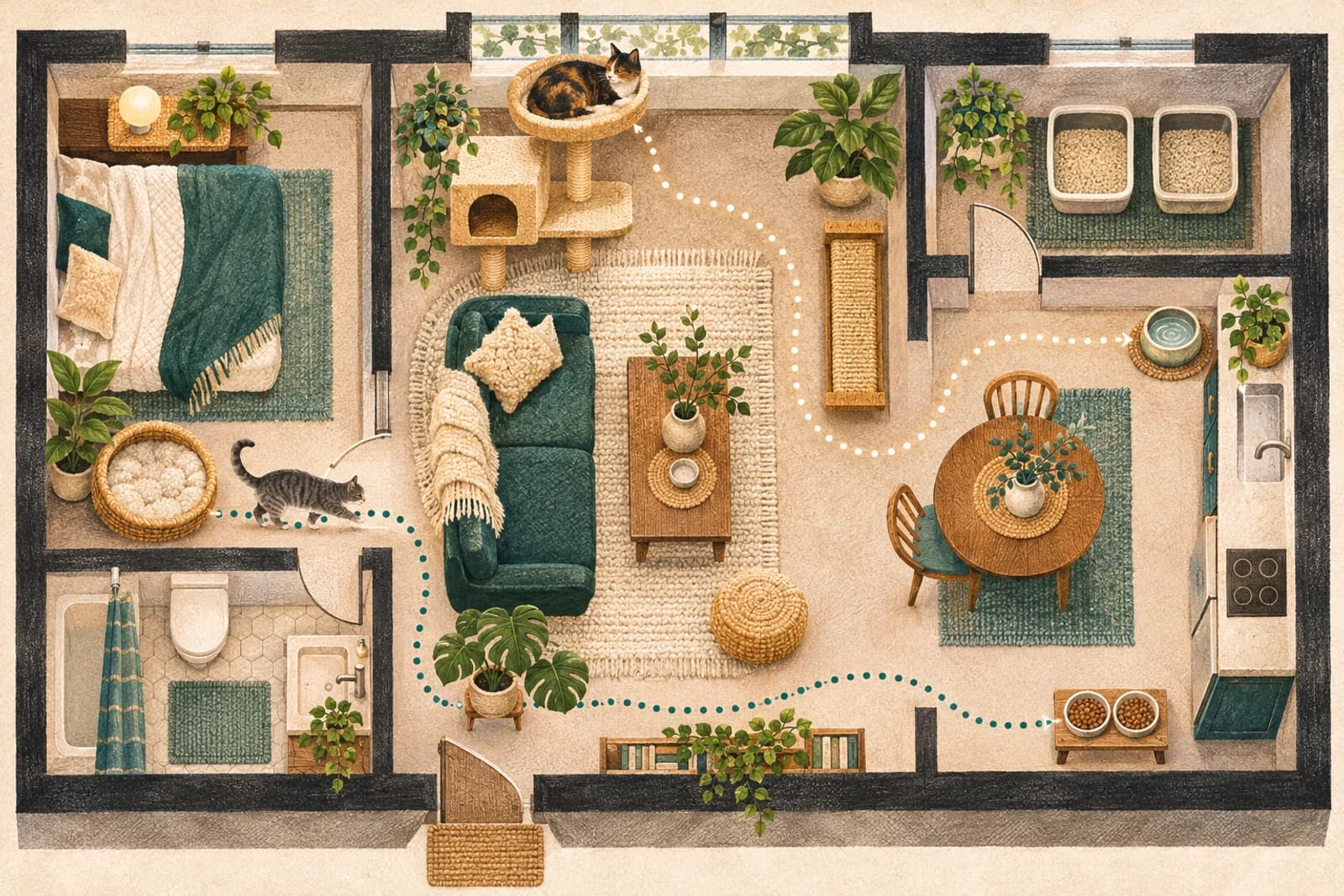
In a hypothetical two-cat apartment, the kitchen opens off a narrow hall, the living room sits at one end, and a bedroom and bathroom open near the other. Juniper, a mobile adult, spends much of the afternoon on a living-room shelf. Moth, an older cat, rests on a low bed in the bedroom. The caregiver counts two food dishes, two water bowls and two litter boxes. On paper that looks like a choice. On the floor plan, both dishes are in the kitchen and both boxes are in the bathroom. From Moth’s bed, nearly every trip goes through the same stretch of hall.
The feline environmental needs guidelines from the American Association of Feline Practitioners and the International Society of Feline Medicine recommend safe retreats and multiple, physically separated resources for feeding, drinking, toileting, resting and scratching. Apply that idea by tracing a route from each cat’s usual resting spot to each resource. Mark where the cats have to pass close to each other and where either can turn away. Two bowls on opposite sides of a small kitchen still share an entrance. If one cat regularly sits in that doorway, the second bowl does not give the other cat a way to reach food without passing that spot.
Put a time and a sequence on what happens at the pinch point. A hypothetical note might read, “6:05 p.m.: Juniper sat in the hall opening. Moth stopped at the bedroom threshold. After Juniper went into the living room, Moth crossed the hall and approached her dish.” It does not say Juniper guarded the hall or Moth was afraid. The caregiver saw positions and movement, not intent. If the sequence happens again, record whether it is at the same time and whether the destination is the same. A pattern can guide a discussion about placement without establishing that competition or stress explains a change in behavior.
Now sketch a layout with genuinely different routes. Juniper can approach her feeding spot from the living room while Moth can reach hers within the bedroom without crossing the hall. Place drinking spots separately rather than moving both bowls together. If the bedroom has room for a litter box away from food and water, Moth has a toileting option that does not require going past the bathroom doorway. Mark a scratching surface near each cat’s usual resting area instead of making both cats cross the living room to reach a single post. The useful comparison is not how many supplies fit in the apartment but what each cat can reach from where it spends time.
Resting places and retreats deserve separate marks on the map. Juniper’s shelf is a resting place she reaches on her own. It is not an accessible option for Moth simply because there is enough room for another cat. Mark a low, sheltered retreat Moth can enter and leave without being lifted, and make sure access does not depend on someone remembering to open a door. The joint AAHA and AAFP feline life-stage guidelines call attention to mobility and litter-box access, including the stairs a cat may have to negotiate. For a veterinarian reviewing the sketch, include the height of any step or threshold you are concerned about, not just the room name.
Add play and human activity to the map. The feline environmental guidelines include opportunities for play and predictable, positive interaction. In this apartment, a caregiver might move a familiar toy along the living-room rug for Juniper to watch, stalk and pounce on, then offer Moth a separate chance to follow and catch a toy near her bedroom bed if she chooses to engage. Note where each cat joins in or walks away. Predictability can be as simple as offering play in a familiar place at a usual time, without reaching into a retreat to pull a cat out. The goal is to make play available without requiring both cats to approach the same person in the same narrow space.
A floor plan should reflect the apartment as used, not just as drawn. The bedroom door may be open during the day but shut during a work call; the hall may be empty in the morning and busy at dinner. Mark those differences when they affect a route. If you add a resource, date the change and record whether you actually see either cat use it. A quiet corner that looks convenient to a person may not be on either cat’s usual path. Finding that out is useful even if neither cat shows an obvious change: it tells you which options you’ve confirmed and which are still only possibilities.
Bring the sketch and two or three observations to the clinic. Ask, “Which of these locations would give Moth another usable route to a box?” “Is the threshold or box entry something you want to assess given how she’s moving?” and “If she starts taking a different route or stops using a familiar resting spot, when should I call?” Describe any change that has already happened rather than waiting to see whether moving a dish fixes it. The environmental guidelines explain how to offer cats more practical choices. They do not tell you whether a particular cat’s new behavior reflects a medical problem, competition for access or something else.
Sources for this section: AAFP and ISFM Feline Environmental Needs Guidelines; 2021 AAHA/AAFP Feline Life Stage Guidelines.
6. Cats: Make litter-box notes without guessing who did what
**Call a veterinarian immediately if a cat repeatedly strains to urinate and produces little or no urine.** The Cornell Feline Health Center warns that different urinary problems can look alike at home and that this pattern can indicate an obstruction. Do not wait for another clump, assume the cat is constipated or try to settle the question by watching for one more attempt. If you see repeated straining and can’t tell whether the cat is trying to pass urine or stool, describe what you saw when you call. You don’t need to identify the cause or finish a litter-box entry before getting help.
On an ordinary day, distinguish the box from the animal in the record. In the hypothetical apartment, call the boxes “bathroom, beside the vanity” and “bedroom, far wall,” so that both caregivers identify the same locations. A morning entry could read, “7:10 a.m., Jess: scooped bathroom box, removed two urine clumps and one stool; cats not seen using it. Scooped bedroom box; one clump, cat unknown.” The time identifies when the contents were found and removed, not when either cat used the box. If yesterday’s cleaning time is unknown, do not assign the contents to a particular overnight interval.
Then add directly observed visits as separate entries. “8:05 a.m., Jess: saw Moth enter bedroom box, squat and pass urine; fresh clump visible after she stepped out.” That entry can go in Moth’s individual history. “12:40 p.m., Lee: saw Juniper step out of bathroom box; did not see what she did inside” is a visit, not a confirmed urination. At the evening scoop, a new clump in that box stays unidentified. The fact that Juniper was the only cat seen near it does not establish that she made it. Overlapping notes can refer to the same event, so don’t count a witnessed urination and the later removal of its known clump as two events.
A shared-box clump count is a household observation. It is not an individual urine record, and the size of a clump is not a measured urine volume. If a caregiver scoops at breakfast but another checks only after dinner, the notes cover different intervals. If someone cleaned a box without recording when, mark the interval as uncertain instead of comparing its count with a full day’s tally. These distinctions matter when someone asks, “Has Moth urinated today?” A useful answer might be, “I saw her urinate at 8:05 a.m.; I can’t identify the later clumps.” If nobody saw her go, say that instead.
Contrast an unwitnessed afternoon with something a caregiver actually sees. “Away from noon to five; no visits observed” says nothing about what happened while the home was empty. “At 5:15 p.m. Moth entered the bedroom box, crouched and strained, stepped out, then returned twice over the next ten minutes; saw a few drops on one attempt” is different. The last normal urination may be unknown in both cases, but only the second entry documents repeated attempts with very little output. A normal-looking clump in the bathroom box does not make that observation less urgent, even if the caregiver thinks Moth may have left it earlier.
On the emergency call, use the details you already know: “My cat Moth has strained three times since about 5:15, over roughly ten minutes. I saw only a few drops. She cried on the last attempt and is still going back to the box. I don’t know when she last passed a normal amount. Can you see her now?” If you didn’t see drops or hear crying, say what you did see rather than filling in the script. Report uncertainty about which cat used a shared box if the team asks, but don’t stop to inspect the litter again before making the call.
For a routine discussion about a box the cat is using, bring its location, inside dimensions and entry height, plus the usual cleaning schedule and any recent departures from it. The joint AAHA and AAFP feline life-stage guidelines identify box dimensions and access as useful topics, especially when mobility may affect the route. Ask, “Is there enough room for her to turn comfortably?” “Would a lower entry or a different location make this box easier to reach?” and “What cleaning routine would you suggest for these boxes?” If a door was closed or the box had just been scooped, note that as context, not as an explanation for what the cat did next.
If Moth starts using the bedroom box but no longer uses the bathroom box when you’re watching, record the first date you noticed and what you observed, including whether the bathroom was accessible. Avoid writing “refuses the bathroom box” if all you know is that you no longer see her there. The feline environmental guidelines make placement and access worth discussing, but a newly avoided box, a different route or a change in elimination cannot by itself distinguish a medical issue from an environmental or behavioral one. Call the clinic about a new concerning change to ask how soon it should be assessed. Keep immediate warning signs out of the routine discussion queue.
Sources for this section: Feline Lower Urinary Tract Disease; 2021 AAHA/AAFP Feline Life Stage Guidelines; AAFP and ISFM Feline Environmental Needs Guidelines.
7. Cats: Notice changes in eating, jumping and grooming
Moth, the older cat in the two-cat apartment, still walks to her breakfast dish when Jess puts it down. This week she takes a few bites and walks away, leaving food she usually finishes while Jess makes coffee. At dusk, instead of going from the sofa arm to her favorite window shelf, Moth settles on the sofa cushion. “Still comes for breakfast” and “still spends time by the window” both sound reassuring, but neither captures the change. The joint AAHA and AAFP feline life-stage guidelines caution against attributing subtle changes in an older cat to age alone. Write down what changed and call the clinic about the reduced intake rather than waiting for the next wellness visit.
Separate the trip to the dish from what happens once the cat arrives. At 7:10 a.m. Monday, Jess might write, “Moth reached her usual dish without stopping; Juniper was in the living room. Offered 45 g of her usual wet food. Saw Moth eat for about a minute and leave. Picked up the bowl at 7:25; 30 g remained and no other cat reached it.” The quantities describe a fictional meal, not a serving recommendation. The note establishes that Moth reached the dish and ate some food. It does not establish that her appetite was normal, that eating was comfortable or why she left.
A less complete observation can still be useful. On Tuesday, Lee puts out the same food, sees both cats in the kitchen, then leaves to answer the door. When Lee returns, Moth’s dish is empty. Write “dish empty on return; eater not confirmed,” not “Moth finished breakfast.” To get a clearer view next time, serve each cat its usual food at its own familiar station and watch quietly during the part of the meal you can see. There’s no need to shut either cat behind a door or change foods to see whether Moth will eat more. If either cat switches dishes, note the time and leave the amounts unassigned.
Watch for access differences that a food tally alone would miss. On Wednesday, Moth may stop at the kitchen threshold while Juniper is there, then approach the dish once the hall is clear. That is different from Monday, when Moth reached her food without pausing but left most of it. Keep both entries rather than picking one to explain the week. The AAFP and ISFM feline environmental guidelines recommend physically separated resources; the notes can help the clinic discuss where a dish is easiest for Moth to reach. Pick up leftovers as part of the usual routine. The FDA advises promptly refrigerating or discarding leftover canned or pouched pet food; don’t leave it out longer just to improve the tally.
For the shelf, record the route as well as the destination. “Monday, 6:20 p.m.: stood on the sofa arm facing the shelf, stepped back onto the cushion and lay down” describes one occasion. “Tuesday and Wednesday, during the usual evening window time: went onto the sofa but stayed on the cushion” adds a repeated change during comparable periods. An afternoon when nobody was home belongs in the unknown column. If Moth later reaches the shelf, record how she got there rather than erasing the earlier entries. Don’t lure her up to test the jump. The clinic can use the height and layout of the route without a demonstration.
Use similarly specific comparisons for grooming, play and interactions. “After breakfast she washed her front paws as usual; did not see her turn to groom her flank during that session” is narrower and more useful than “stopped grooming.” If she normally follows a toy from the rug to the sofa but now watches from the rug, describe what was offered and what she did. Note whether she still comes to sit beside Lee at the usual hour. These are behaviors a second caregiver can recognize. A label such as “low energy” gives that caregiver no way to tell whether a familiar habit changed or a different person just used a different word.
If the veterinarian approves home weighing and Moth tolerates it, use the same scale and a consistent method. Two hypothetical entries might read, “May 4, 8 a.m., home pet scale, 4.3 kg” and “May 11, 8 a.m., same scale, 4.2 kg.” If a reading is taken on a different scale or Moth steps off before it settles, mark that rather than treating it as directly comparable. The clinic can decide how useful the values are alongside the meal and movement observations. If weighing isn’t practical, say so. A missing weight is not a reason to postpone a call about eating less.
When you speak with the clinic, start with what it can act on: when Moth first left more food than usual, how much you actually saw her eat, and which meals could not be attributed to her. At the visit, ask: “How should we track her weight from here?” “Could you assess her mouth and teeth given the change we saw at meals?” “Which resting and feeding spots should we make easier to reach?” and “If she leaves food again, what should prompt a call that day?” Bring the notes on the shelf and grooming even if those changes don’t happen at the appointment. They describe how Moth is doing at home without assuming the changes share a cause.
Sources for this section: 2021 AAHA/AAFP Feline Life Stage Guidelines; AAFP and ISFM Feline Environmental Needs Guidelines; Proper Storage of Pet Food & Treats.
8. Companion birds: Record the species before writing the schedule
Put the species beside the bird’s name at the top of the feeding sheet. A sitter who has fed a cockatiel should not have to infer what belongs in a lorikeet’s cup. The Association of Avian Veterinarians distinguishes nectar-feeding birds from other companion birds in its basic care guidance. In a hypothetical pair of records, the cockatiel’s sheet points to the exact foods on that bird’s current veterinary plan, while the lorikeet’s identifies the specific nectar food approved for that individual and refers to its own preparation and removal instructions. The point of the comparison is not to supply two menus. It’s to show why a sheet headed only “bird food, morning and evening” can misdirect someone doing the feeding.
Make the feeding line usable by someone who didn’t buy the food. Copy the exact name and form of each approved item from the current plan and say where it is kept. Next to each item, leave room for what was offered, in the units the plan uses, when it went in and when it was removed. Give fresh water its own line, with space for the time it was provided and the caregiver’s name. A check beside “fresh water provided” documents the task, not how much the bird drank. If a sitter cannot match a container to the instructions, the sheet should say whom to call rather than asking the sitter to pick the closest-looking product.
For the hypothetical cockatiel, imagine that seed is one component already approved by the avian veterinarian. Jess writes, “7:30 a.m.: offered the listed foods in their usual dishes. At 7:40 I saw him open and eat several seeds. At pickup I saw loose hulls and some intact seeds; total eaten not measured.” Loose hulls can make a dish look full even after some seed has been eaten. Intact seeds tell you something was left, but the overall level in the dish doesn’t measure intake. If Jess simply saw the bird at the bowl, the entry should say that. Seeing a bird pick through a dish isn’t the same observation as seeing it swallow food.
Use a different entry for the lorikeet. A hypothetical sitter might record, “7:30 a.m.: offered the approved nectar food following the posted instructions; supplied fresh water. Saw the bird feed from the nectar cup at 7:45. Removed food at the time on the care sheet; some had spilled, so intake not measured.” The change in level can’t all be counted as food eaten when some is on the liner. Serving and removal times establish whether the sitter followed this bird’s plan. They aren’t rules for another household, and the cockatiel’s dish schedule should not be carried over to the lorikeet. Record a missed or late removal as such instead of filling in the scheduled time.
Set meal observations beside a brief description of the bird’s usual day. Jess’s cockatiel might usually start moving among the perches after the morning uncovering, call while breakfast dishes are put out, and spend part of the morning searching a familiar foraging setup. In the afternoon he may be quieter while resting, then whistle again when the household gathers before dinner. Write down when he usually has social time and when the room goes quiet for sleep. These are examples of one bird’s pattern, not a schedule to impose on another cockatiel or a lorikeet. A sitter can compare breakfast with breakfast rather than comparing a quiet rest period with the liveliest part of the previous day.
Describe the observation window so the regular caregiver knows what the sitter could have seen. “Lee, 7:30 to 7:50 a.m.: awake on usual perch; no calls during food delivery; approached the dish twice, did not see him eat” is more useful than “quiet and off food all morning.” If Lee had never heard the bird at breakfast before, the usual caregiver’s description supplies the comparison; Lee doesn’t have to judge how unusual the silence was. The Association of Avian Veterinarians identifies changes in eating and vocalization as possible early signs of illness. A change in both deserves a call, not a trial with a more appealing food to see whether the bird perks up.
Keep any planned diet conversion off the sitter’s list of decisions. The Association of Avian Veterinarians advises getting veterinary help with conversion. If the owner and avian veterinarian are discussing a change, leave the current approved plan clearly marked and distinguish it from notes about options not yet in use. In a home with more than one bird, label dishes and supplies by bird and don’t borrow from a new arrival’s set. CDC guidance calls for separate equipment during new-bird separation. Even if two cups look identical, the sitter needs to know which belongs to which bird and what to do if the correct one is missing.
Give the sitter a direct instruction: if the bird appears to be eating less than usual, call the avian clinic right away, then tell the owner. Don’t substitute the other bird’s food or wait for the next scheduled weigh-in. A useful call might begin, “I’m caring for a cockatiel. I offered his usual breakfast at 7:30. He went to the bowl twice, but I didn’t see him eat, and the owner says he normally eats while the dishes are being set out.” Add what you actually saw him eat and what you couldn’t measure. The clinic can advise on what to do next without the sitter first having to prove how much food is missing.
Sources for this section: Basic Care for Companion Birds; Signs of Illness in Companion Birds; Birds.
9. Companion birds: Plan for the room, not just the cage
Stand where the caregiver stands to open the cockatiel’s enclosure and look at what happens on both sides of the door. Inside, the bird needs room to move among perches without having to squeeze past dishes or toys. Outside, the same door may face a hallway that leads to an exterior entrance. The Association of Avian Veterinarians’ basic care guidance addresses enclosure security, space, perches, enrichment and sleep. Put the checks that matter for this particular setup on the room plan: which latch secures the main door, which smaller doors are opened for service, and which perches the bird uses to reach resting spots and food. A sketch can show things a cage model name cannot.
Walk through the arrangement as it is used. In the hypothetical living room, adding a hanging toy between the cockatiel’s regular perch and the food dish might leave less room along the route, even though the enclosure itself hasn’t changed. Record what was moved and when: “Saturday, shifted hanging toy from beside the main perch to the far side; usual route to dish clear.” If the bird subsequently uses a different perch, describe where you saw it and at what time. The note helps a caregiver and the avian veterinarian discuss the layout without assuming a new perch choice is either a problem or proof that an arrangement is better.
Now picture an evening when a television stays on late, someone uses a scented cleaning spray in the living room, and dinner is cooking in the adjoining kitchen. These are three different entries. The television may change when the room becomes quiet and dark enough for an uninterrupted sleep opportunity. The spray is a product released into the bird’s room. Cooking may affect the air in both spaces. Write “TV and lights on past usual quiet time” rather than “bird slept an hour less” unless you actually know what happened. For the spray and cooking, record where and when they occurred and what product or cookware was involved if known.
The Association of Avian Veterinarians warns that overheated nonstick surfaces containing PTFE, such as Teflon-coated cookware, can release fumes that are dangerous to birds. Don’t use the presence or absence of an odor to decide whether there was an exposure. Nor does moving the cage farther from the stove establish that air shared with the kitchen is safe. Use the floor plan to identify where air may be shared, not to certify any spot as safe. In the hypothetical home, an open passage connects the kitchen to the living room. That’s useful context to give the avian veterinarian when asking how to prevent exposure. It doesn’t tell a caregiver what reached the bird on a particular evening.
Put planned work on the room record before it happens. For example: “Thursday morning, repainting the hall outside the bird room; product and work hours to be confirmed.” Give the avian clinic the location, timing and product information available and ask whether the bird needs to be elsewhere, what arrangements are appropriate, and what should determine when it can return. Use the same approach for maintenance that introduces an unfamiliar spray or other airborne product. The fact that a job is outside the enclosure or happens when the bird is inside it doesn’t answer an air-quality question. Keep the clinic’s instructions with the plan so the person meeting the contractor has them.
A supervised out-of-cage period needs a check before the door swings open, not after the bird is out. CDC guidance recommends supervising out-of-cage activity. In the living-room example, the caregiver checks that exterior doors and windows are secure, that the people using the hall know the bird will be out, and that the dog and cats are kept out of the room. Identify the person who will stay and supervise until the bird is back inside and the door is latched. If Lee has to step away to receive a delivery, the session can wait. Record “not offered because I couldn’t supervise,” rather than making it sound as though the cockatiel declined to come out.
Keep a separate, prominent instruction for suspected exposure to hazardous fumes. If a nonstick pan overheats while the cockatiel is in the adjoining room, move the bird to fresh air immediately if you can do so safely, and call an avian veterinarian or an emergency hospital that accepts birds. Don’t wait for a smell or a change in the bird’s behavior before seeking care. Tell the clinic what happened, when it happened, where the bird was and what you see now. If you don’t know what the pan was coated with, say so rather than stopping to look it up. Follow the receiving team’s transport instructions.
Breathing difficulty, bleeding, severe weakness or inability to perch call for immediate veterinary help, whether or not you know of an exposure. The Association of Avian Veterinarians identifies breathing difficulty, blood loss and inability to perch as urgent signs. If the cockatiel is struggling to breathe after the cooking incident, that observation belongs at the start of the call, ahead of the details about the stove or room. Don’t weigh the bird, film its breathing or go back for a product label before seeking help. The room notes are useful if they’re already at hand. The emergency number and the location of the bird’s transport enclosure should be easier to find than the notes.
Sources for this section: Basic Care for Companion Birds; Birds; Signs of Illness in Companion Birds; New Emergency Service Established for Companion Exotic Pets; Teflon (Polytetrafluoroethylene) Poisoning in Birds.
10. Companion birds: Use weights and droppings to describe change
**Get veterinary help immediately if a bird has difficulty breathing, is bleeding, is severely weak or cannot perch.** The Association of Avian Veterinarians identifies breathing difficulty, blood loss and inability to perch as urgent signs. UC Davis veterinary hospital guidance also flags severe weakness and remaining at the bottom of the cage without perching. Call the avian veterinarian or the emergency service that accepts birds and lead with what is happening now. Do not try to put the bird back on a perch to check, wait for a second weight, take a photograph or put down a fresh liner before calling. A reassuring number from an earlier entry does not change the urgency.
For observations on an ordinary morning, the liner gives you a defined place to look. The Association of Avian Veterinarians recommends plain paper changed daily so that droppings are easier to see. Note when the paper went in and when you looked at it. In a hypothetical cockatiel’s record, Jess writes, “Tuesday, 7:20 a.m.: replaced the plain paper. At 8:20, counted five separate droppings on the paper; four looked like his usual green-and-white droppings, and one had a darker reddish solid portion.” That is a count of what Jess could distinguish on the liner, not a guarantee that it captured every dropping. Smears, overlaps or material on a perch can make a count uncertain.
Use the same observation window to describe what the cockatiel actually did. Jess adds, “From 7:25 to 7:45, moved from the sleeping perch to the food perch and called twice while I was at the enclosure. Saw him swallow several bites of his usual food, including a piece of red pepper from his approved plan. Total intake not measured.” These details are more useful than “ate normally” when nobody watched the full meal. If a second caregiver checked the paper but was not present at breakfast, that caregiver can record the count without confirming what the bird ate. Keeping those observations separate also prevents the food from becoming an assumed explanation for the color.
If you suspect blood or can’t tell whether the reddish material is blood, call the avian clinic right away. Don’t wait for another dropping. Tell the clinic what the dropping looked like and what the cockatiel ate, including the red pepper, without assuming the pepper caused the color. In a different version, Jess sees droppings that differ from usual and notices that the cockatiel stays on one perch during a period when he normally moves about. She also sees him eat less than usual at breakfast. Call the avian clinic immediately about that combination rather than collecting more entries.
The comparison that matters is with the same bird under similar conditions. The Association of Avian Veterinarians notes that normal droppings vary with species and diet. A nectar-feeding lorikeet can have wetter droppings than a cockatiel; the cockatiel’s liner is not a reference chart for the lorikeet. Even for one animal, a liner checked after an hour and one checked after a workday cover different intervals. If Lee can’t tell when the previous caregiver changed the paper, “six separate droppings visible at 5 p.m.; liner start time unknown” preserves what Lee knows without making the number comparable to Jess’s morning count.
For routine tracking, the Association of Avian Veterinarians recommends weekly weighing on a gram scale as general guidance. Ask the avian veterinarian whether that schedule fits this bird, how to obtain a reading without a struggle, and whether a familiar scale perch or another setup would work. Agree on when to weigh relative to the bird’s usual routine and what reading or trend should prompt a call. In a fictional log, “Tuesday, 8:30 a.m., 91 g, home gram scale, usual perch setup, settled reading” is a usable entry, not a target for cockatiels. If the bird steps off before the display settles, mark the reading unavailable rather than writing down the first number that flashed.
Give the clinic the most relevant observations first. A call about the second version might start, “My cockatiel is staying on one perch instead of moving around at breakfast, and I saw him swallow less than usual. I noticed droppings that looked different at 8:20. His last routine weight was 91 grams on Tuesday; I haven’t weighed him today.” If asked, say when the liner went in and describe what looked different. Before leaving a healthy bird with a sitter, put the clinic’s agreed call thresholds beside the weighing instructions, not on the scale alone. The sitter should know whom to call even if there is no reliable weight to report.
Sources for this section: Signs of Illness in Companion Birds; Basic Care for Companion Birds; New Emergency Service Established for Companion Exotic Pets.
11. Reptiles: Record where heat, light and humidity are measured
Sketch the enclosure from the side so another caregiver can tell which readings describe the places the bearded dragon actually uses. An example sketch key could read: “Top left: basking heat source and separate UVB fixture above the basking shelf; mesh between fixtures and shelf. Left below mesh: basking shelf, surface check point A. Beside shelf at dragon height: warm-side air probe B. Right: cooler retreat, air probe C beside its entrance. Humidity sensor D near the retreat; thermostat probe T marked separately.” Add the lamp’s position relative to the animal on the shelf, not just its height above the floor, and draw any glass, plastic or screen along that path. This is an example of how to document an existing enclosure, not a placement plan.
UC Davis School of Veterinary Medicine’s bearded dragon guidance describes a warm-to-cool gradient and UVB lighting. The Merck Veterinary Manual explains that a gradient lets a reptile choose among conditions and that heat sources should be appropriately controlled and shielded from contact. These are different checks: the dragon needs to be able to reach the areas shown on the sketch, and the heat source needs suitable control and protection. Mark any furnishing that changes access to the shelf or retreat. If a caregiver moves the shelf, the lamp may be the same distance above the enclosure floor while the dragon’s position relative to it has changed.
Give the thermostat setting its own field. It is the value the controller is set to regulate toward using its probe, not a reading from every spot in the enclosure. In the hypothetical log, a caregiver records the controller set point under “equipment settings,” then makes separate entries for “A, basking shelf surface, °C, surface thermometer” and “B, warm-side air, °C, fixed air probe.” The units are the same, but one reading describes the shelf and the other the air beside it. Neither substitutes for “C, cool-side air, °C, fixed air probe.” Even two air readings should not share an unlabeled column if one is taken near the shelf and the other near the retreat.
Make a reading reproducible without assuming it must be taken at a particular hour in every home. A line might begin, “June 8, 9:15 a.m., Lee, 75 minutes after lights came on,” followed by the point letter, measured value, unit and device. For humidity, use a separate entry such as “D, beside cooler retreat, % relative humidity, fixed sensor.” D does not describe the entire enclosure. Merck notes that humidity needs and the usefulness of local humid areas differ by species, and that restricting ventilation is not a safe shortcut. Ask which locations are meaningful for this dragon and whether the current sensor placement answers the clinic’s question before acting on one display value.
The lighting record needs more than a checkbox for “on.” Write down the fixture and lamp identifiers, the scheduled on and off times, the actual times if an interruption is known, and the date the lamp was installed. On the sketch, record the measured distance from the lamp to the dragon’s usual basking position and identify any barrier, so the veterinarian can review the actual arrangement. UC Davis points out that a lamp can still produce visible light after its UVB output declines. Merck notes that glass and many clear plastics can filter UVB and that a “full spectrum” label does not establish usable UVB. “Lit at 9:15” confirms visible light, not the UVB reaching the basking spot.
Date setup changes even if all the displays still look familiar. Suppose Lee replaces the UVB lamp on June 8, then moves the basking shelf the next day. Record the installation and the shelf move as separate entries and update the sketch to show the new geometry. If the cool-side probe was also knocked out of place and found lying on the floor, mark readings from the affected period as uncertain rather than filing them as measurements at C. An old diagram can help explain which readings came from the earlier setup, so keep it dated instead of overwriting it. A reading taken at a new location may describe that spot accurately without being comparable to the earlier series.
Review the sketch and a few entries with the reptile veterinarian. Ask, “Which points should we measure, with which devices, and at what times relative to the light cycle? What targets and variation are appropriate at each point for this dragon? How should we verify UVB for this fixture, distance and barrier, and what should guide replacement?” Ask the clinic to review the thermostat probe location and how the heat source is kept out of contact. Example lamp distances or replacement intervals in a husbandry reference do not settle those questions for every setup. Put the clinic’s answers beside the point labels so the next caregiver knows which measurement to take and which discrepancies warrant a call.
Sources for this section: Bearded Dragon Care; Management and Husbandry of Reptiles.
12. Reptiles: A dragon, a snake and an aquatic turtle need different records
Put three observation cards next to one another in the care binder, each headed with the animal’s name, exact species and the date of its current veterinary plan. The columns should look different even when the same person fills them in. At a glance: “Bearded dragon: life-stage feeding plan, plant and insect offerings, basking access” | “Pet snake: scheduled offer, acceptance, last shed, usual activity” | “Aquatic turtle: water reading, dry basking area, platform access, filtration.” The California Veterinary Emergency Team’s field guide treats lizards, snakes, and turtles and tortoises separately. Its disaster-care chapters help identify what a substitute needs to know, but they are not a substitute for a long-term plan for the animal at home.
On the dragon card, keep the life-stage plan next to the daily offerings. UC Davis’s bearded dragon care sheet discusses both plant and insect foods and notes that feeding differs with age. A hypothetical entry for an adult might read, “Monday morning, Jess: offered the plant foods listed on his plan; saw him take several bites. At the planned insect offering, saw him take two of the items offered; didn’t observe the whole feeding. Basking shelf accessible; saw him on it later that morning.” In the actual card, name the foods and note amounts offered and what remained when known. The example describes what a caregiver saw, not a meal size or a ratio to use.
On the snake card, put “offer due?” before “accepted?” A day with no offer per the individual’s approved schedule is not a refusal. A hypothetical pair of notes might say, “Tuesday: no offer scheduled” and “Friday evening: offered the item specified on the current plan; did not see the snake take it; item still present when removed.” If the caregiver could not confirm what happened to an offered item, mark acceptance unknown instead. Keep the date of the last observed shed on the card, with a note if the date is approximate, and describe usual activity at a relevant time. “Usually seen moving between hides after the room goes quiet” is a more useful comparison than “active,” especially if a sitter only visits in daylight.
On the aquatic turtle card, label the water measurement and the dry basking area separately. The California Veterinary Emergency Team’s field guide calls for appropriate water temperature and access to a fully dry basking area for aquatic turtles. A hypothetical entry might read, “Wednesday, 5 p.m., Lee: water temperature measured at the marked point, value in °C entered under water. Dry platform clear and ramp in place; saw turtle climb onto platform earlier, did not see it bask during this check. Filter stopped during scheduled maintenance and was running when checked afterward.” Record a change in water level or platform position if it affects access. A normal water reading cannot tell you whether the dry area was reachable or what conditions were like there.
Compare what an empty feeding line would mean on each card. Wednesday might be a day with no snake offer due, a missed observation for the dragon because the caregiver put food down and left, or a scheduled turtle feeding at which the caregiver saw food offered but no feeding. Those are three different entries: not scheduled, intake unknown and not seen to eat during a defined check. None can be interpreted just by counting days since someone last wrote “ate.” When asking the clinic about a gap, give the species and its own schedule, the last confirmed intake, the offers since then and what changed. A snake’s interval between meals is not a benchmark for a lizard, and one pet’s prior pattern cannot establish what is safe for another.
Put the handling and cleanup notes on the appropriate card rather than beside a communal food scoop. CDC guidance notes that reptiles that appear healthy can carry Salmonella and that habitats, tank water and feeder rodents can also be sources of exposure. For the turtle, name the designated bucket and where it can be cleaned away from food areas. For a snake whose approved diet includes frozen feeder rodents, identify its dedicated supplies and label where they belong; freezing does not kill the germs. The dragon’s plant-food entry is not a reason to bring enclosure equipment into the kitchen. These are household hygiene distinctions, not instructions for choosing prey, preparing a ration or setting a maintenance interval.
Use the three cards to ask questions the sitter can act on. For the dragon: “Which parts of the feeding plan change as he matures, and when should we call about a change in intake or basking?” For the snake: “If an offer is not accepted, what should we record, and when do you want a call rather than another offer?” For the turtle: “Where should we measure the water and basking conditions, and what change in platform access or filtration should prompt contact?” Record each answer on the individual card as dated veterinary guidance. That way a substitute can tell the difference between a routine gap, a task they still need to confirm and a change the clinic wants to hear about.

Sources for this section: Bearded Dragon Care; Management and Husbandry of Reptiles; Avian, Small Mammal, and Exotics Feeding Guide; Reptiles and Amphibians.
13. Reptiles: Separate what the animal did from what the enclosure did
**Call an emergency veterinary service that accepts reptiles immediately for labored or open-mouth breathing, weakness, unresponsiveness, bloody droppings or prolonged straining to pass stool or an egg.** UC Davis veterinary hospital guidance identifies these as warning signs in reptiles. If you’re unsure whether you’re seeing a brief basking gape in a bearded dragon or a breathing problem, call immediately. You don’t have to decide whether the animal is in respiratory distress before you pick up the phone. Give the clinic any recent enclosure readings you already have, but don’t take new ones, move the animal to see how it responds or film its breathing before calling.
On an ordinary day, give the reptile log two columns that share a date and time. On the left, write what the animal did: whether it accepted food, where it moved, when you saw it shed, what droppings you found and any visible change in breathing. On the right, write what happened to the enclosure: equipment interruptions, temperature readings, water maintenance and changes to the setup or room. For an aquatic turtle, a filter interruption goes on the right; seeing the turtle climb onto the dry platform goes on the left. The California Veterinary Emergency Team’s field guide treats water conditions and dry basking access as separate needs. Neither column can stand in for the other.
In the following hypothetical timeline, read each line left to right: Animal observation | Enclosure or room observation. A blank would be ambiguous, so the caregiver writes down what was not checked.
Monday, 8:40 a.m. | Animal: Bearded dragon walked from the cooler retreat to the basking shelf and later took several bites at the usual offering; total intake not measured. A loose piece of shed was visible on the tail; no droppings seen during the check. | Enclosure: Room window was open when Jess arrived. Warm-side air reading entered from the fixed probe beside the shelf, with the value and unit. Shelf surface not measured.
Monday, 6:15 p.m. | Animal: On the shelf at the start of the check with mouth briefly open, then closed. Jess had seen that posture on the shelf before, but couldn’t tell whether the dragon was working harder to breathe, so she called the reptile emergency service immediately. | Enclosure: Later that evening, Jess shut the room window and replaced the UVB lamp, recording when it went in. The lamp lit. UVB output was not checked.
Tuesday, 8:45 a.m. | Animal: Stayed in the cooler retreat throughout Jess’s 20-minute check instead of making the usual morning trip to the shelf. Food was offered; Jess did not see any taken before leaving. One dropping was found near the retreat; time passed unknown. | Enclosure: Window still shut. Same warm-side air probe read as usual for that time; exact value recorded in the measurement log. Shelf surface and UVB not checked.
The order is useful: the window closed and the lamp changed before Jess noticed less movement. It doesn’t establish whether the changes mattered, whether something else happened overnight or whether the change in activity began earlier. The Merck Veterinary Manual describes the importance of a temperature gradient, and UC Davis’s bearded dragon care sheet notes that visible light can persist after UVB output has declined. A familiar air reading at one point doesn’t describe the whole enclosure, and a lamp that lights doesn’t verify the UVB reaching the animal. Call the reptile clinic about the change in activity and ask how soon the dragon should be seen. Tell the clinic that food was offered but you didn’t see any eaten during the check. Don’t reopen the window, move the lamp and adjust the heat as a home experiment to see whether the dragon moves more.
The Monday note is a description of the dragon’s familiar posture in a particular spot, not a rule that an open mouth on a basking shelf is harmless. Suppose Jess returns Tuesday and sees the dragon in the cooler retreat with its mouth open and its sides moving much more noticeably with each breath. The useful comparison is “new, in the retreat, with visible effort,” not “probably basking” or “definitely caused by the lamp.” Call immediately and describe where the dragon is, what the breathing looks like and when it was first noticed. Don’t wait for it to move to a different part of the enclosure to see whether the breathing changes.
When the clinic asks for context, give the last observation you can stand behind. “The warm-side air reading was taken at 8:45; I don’t have a current shelf reading” is better than quoting the thermostat setting as the temperature where the dragon sat. If a second caregiver found an interruption but didn’t see when it began, record the discovery time and say the duration is unknown. Bring or forward the readings and setup notes if they’re handy, and follow the clinic’s transport instructions. The timeline lets the veterinary team reconstruct what was observed without making a complete enclosure check a condition of getting care.
Sources for this section: New Emergency Service Established for Companion Exotic Pets; Management and Husbandry of Reptiles; Bearded Dragon Care; Avian, Small Mammal, and Exotics Feeding Guide; Hypoxia progressively lowers thermal gaping thresholds in bearded dragons, Pogona vitticeps.
14. Mark where cages, tanks and food equipment get cleaned
The cleaning plan for a small apartment might begin with four things a sitter could pick up by mistake: the cockatiel’s paper liner, the turtle’s water-change bucket, the snake’s feeder container and the dog’s food scoop. For each, write where it’s used, where it goes when dirty, where it’s cleaned or discarded, where the clean item or replacement is stored and who handles it. “Wash pet things in the sink” is not a usable instruction if there’s a kitchen sink and a utility sink with different roles. Mark those locations by name. If a shared laundry room doesn’t permit animal equipment, the sitter needs the agreed alternative, not permission to use whichever sink is free.
For the bird liner, the route in this hypothetical apartment starts at the cage and ends at the trash. Clean sheets are stored in a drawer beside the cage, and the adult on bird duty changes the liner and deals with any soiled cage surfaces. CDC’s psittacosis prevention guidance recommends wetting surfaces before cleaning and avoiding dry sweeping or vacuuming that can send dust into the air. It also includes daily cleaning of cages and food and water bowls among its prevention measures. Put the handling note where the sitter will see it before reaching for the vacuum. A check beside “paper replaced” should not also count as “cage and bowls cleaned” if those jobs haven’t been done.
Decide where the bird bowls and washable cage parts go before lifting them out. CDC’s pet-bird guidance says to keep bird equipment out of the kitchen sink and clean habitats outdoors when possible. If cleaning indoors, use a laundry sink or bathtub and thoroughly clean and disinfect the area immediately afterward. Put the location and the person responsible on the sheet. Choose the cleaning approach with the bird’s air in mind. The Association of Avian Veterinarians flags airborne hazards for birds; a product used outside the cage can still affect air the bird breathes. Ask the avian veterinarian about product and location choices for the home. Don’t assume that an open door or a lack of odor makes a spray safe.
The turtle bucket follows a different route. In the example, it’s marked “tank water only” and never doubles as a kitchen pail or a container for washing dog bowls. Reptiles that look healthy can carry Salmonella, and their tank water and equipment can spread it. CDC advises pouring used tank water into the toilet rather than a sink or drain, and cleaning equipment outdoors when possible, away from gardens and sources of food or drinking water. If the bucket must be washed indoors, use the designated laundry sink or bathtub, then thoroughly clean and disinfect that area immediately afterward. Return the clean bucket to its labeled bin.
Label the snake’s feeder container so it’s recognizable even when empty. Assign feeding to someone who can safely do it: CDC advises that children under five, adults 65 and older, pregnant people and people with weakened immune systems should not handle feeder rodents. Freezing the rodents doesn’t kill germs. Keep the container away from human food, wash your hands after feeding, and clean and disinfect the container and anything the rodents touched. Clean supplies outdoors when possible. If using a laundry sink or bathtub, thoroughly clean and disinfect the area immediately afterward. Keep the snake’s feeding instructions on its own sheet so a substitute can identify the right container without borrowing equipment or improvising a feeding routine.
Set the boundary for young children where it applies. CDC advises that children younger than five should not touch reptiles or their environments. On this apartment’s care map, that excludes helping at the tank, touching the enclosure or handling its contents; the bucket and other reptile supplies stay out of reach. An adult completes the work and washes their hands afterward. If a child wants a job, have them mark a reminder away from the tank rather than carry the supposedly empty bucket. The age restriction here comes from CDC’s reptile guidance. It is not a claim that the same rule covers every object in the apartment or that every task is appropriate for a child once they turn five.
The dog scoop stays with the dog’s packaged food, not in the bin of equipment going to the utility sink. Its card can say that the dog’s caregiver uses it at the feeding station, washes and dries it with the dog’s feeding equipment and returns it to the labeled storage spot. FDA pet-food guidance calls for daily washing of water bowls, so put that task on its own line instead of assuming it was done because the food scoop was washed. On a handoff, ask the sitter to point out where each dirty item goes and where the clean one belongs. If the turtle bucket and bird bowls use the same utility area at different times, the plan should keep them from being piled together and identify who leaves the area ready for its next use.
Sources for this section: Birds; Preventing Psittacosis; Basic Care for Companion Birds; Reptiles and Amphibians; Proper Storage of Pet Food & Treats.
15. Keep the package information when the food moves
Make the label entry when you open a new bag or case, while the package and the food are still together. Copy the exact product name and variety, package size, UPC, lot and date code. Add the store or other purchase location, purchase date if known, opening date and first date the food was served. Those dates answer different questions: a bag bought last month may have sat unopened until this week, and opening it to check the seal doesn’t mean anyone ate from it that day. The FDA’s Center for Veterinary Medicine recommends retaining the original package because it preserves the identifying information. A picture of the front can supplement the entry, but it may not show the code printed on a seam or flap.
Consider two hypothetical bags of Milo’s usual dry food. Jess buys them together, and the names, package sizes and UPCs match. The first bag is opened and first fed on May 3. The second goes into storage unopened, then is opened on May 20 and first fed on May 21. When Jess checks the printed codes, the bags have different lots. The log needs two entries even though the scoop, serving routine and front of the bag look the same. A note that says “usual food since May 3” would preserve the menu but lose the change in lot. If a second caregiver can’t tell which bag supplied a particular meal, label that meal’s lot unknown rather than assigning it by date alone.
If a separate container makes storage easier, FDA recommends putting the whole bag inside the bin rather than pouring kibble directly into it. If you do transfer dry food, use a clean, dry container with a tight-fitting lid, and wash and dry it between bags. Retain the original packaging or save legible images of the exact product name, manufacturer, package size, UPC, lot and date code and link them to the container entry. Before discarding anything, check that the code can actually be read; a photo of a fold may miss the last characters. If food from two bags has already been mixed, record both lots and mark the transition uncertain. Don’t make the container label look more precise than the feeding history.
Apply the same distinction to a case of pouched food. In a hypothetical entry, Lee opens a case of Moth’s usual food on June 2 and notices one pouch is swollen before opening it. The note can say, “One unopened pouch visibly swollen; not served,” with the codes from the pouch and case recorded as printed. That is an observed packaging defect. It doesn’t say what caused the swelling, that other pouches have the same defect or that Moth became ill. Conversely, food can be suspected in a health problem even if the package looks ordinary. Keep the defect, the feeding history and any change in the animal as separate facts. FDA also advises promptly refrigerating or discarding leftovers from opened cans and pouches; don’t leave leftovers out while deciding how to document them.
**If you suspect a food is associated with a health problem, stop using that product and call the veterinarian first.** That is the FDA’s advice; a complaint form is not a way to get the animal assessed. Suppose Milo develops a concerning change after the switch to the second bag. Tell the clinic when you first noticed it, when the food was first served and whether you actually saw him eat it. Mention other foods or changes from the same period if known. Don’t serve another portion to test the connection or delay the call while looking for the receipt. Ask the veterinarian what to feed next rather than making the replacement decision from a reporting checklist.
Once the animal’s care is addressed, use the FDA’s pet-food complaint instructions if you report the concern. The agency asks for identifying details such as the exact product, lot and date codes, plus purchase and storage information. For Milo’s second bag, the storage description might distinguish “unopened in hall cupboard until May 20” from “after opening, original bag kept inside a lidded bin.” If someone transferred the contents and the date is uncertain, report that uncertainty. A receipt can help locate the sale, but it doesn’t identify a lot unless the information is actually there. The report helps FDA monitor complaints and look for patterns across households. Filing it doesn’t establish that a food caused an individual animal’s illness.
Keep this packaged-food record from becoming a storage guide for everything the animals eat. A lorikeet’s approved nectar food needs its own preparation, serving and removal instructions from the avian care plan; the FDA advice about leftover canned or pouched food doesn’t establish those times. A snake’s frozen feeder rodents belong on the snake’s separate handling sheet. As CDC notes, freezing doesn’t kill germs, so saving a supplier label is no reason to move feeder supplies into the packaged-food routine. A sitter looking up Milo’s current lot should be able to find it without opening the feeder container, just as the person checking the lorikeet’s nectar instructions shouldn’t have to infer them from a date code.
Sources for this section: Proper Storage of Pet Food & Treats; How to Report a Pet Food Complaint; Basic Care for Companion Birds; Reptiles and Amphibians.
16. Draw the boundaries between pets and outside exposures
On a sketch of the home and yard, mark three routes in different colors: where the animals go, where people enter after spending time outside, and where equipment travels. In a hypothetical household, the cockatiel has a secure outdoor enclosure on the patio. Milo the dog goes through the mudroom to the yard. Moth the cat retreats to a bedroom off the hall, and the bearded dragon’s supplies are stored near the utility sink. A map showing only the animals would miss a visiting dog coming in through the front door and a muddy crate being carried across the patio. Both routes can cross a care area even if no resident pet leaves its usual spot.
For the cockatiel, draw the patio enclosure and mark where wild birds land nearby. The CDC recommends keeping pet birds from interacting with wild animals. In this example, an adult stays with the cockatiel during outdoor time, and the household checks whether wild-bird droppings are present on or inside the enclosure before using it. A latch can keep the cockatiel from getting out without preventing material from falling in from above. If wild birds are landing on the enclosure or droppings are getting inside, pause outdoor use of that setup and ask the avian veterinarian how to prevent contact. Supervision and separation solve different problems.
Now follow someone returning from a hunt. The United States Department of Agriculture’s Animal and Plant Health Inspection Service advises hunters that wild birds can carry avian influenza viruses without appearing sick. It recommends avoiding obviously sick or dead wild birds and keeping game-bird cleaning away from poultry and other birds. On this household’s map, the patio with the cockatiel enclosure is not a game-cleaning location or a staging area for hunting gear. The person coming home has a route and a place for the gear that don’t pass through the bird’s area. This is a precaution for the activity, not evidence that a particular wild bird was infected or that an outbreak is occurring nearby.
Give a new bird its own arrival plan before anyone brings the carrier through the front door. The CDC advises planning a period of separation and keeping dishes, toys and other equipment separate during that time. Write down which room will be used, which supplies belong to the newcomer and who will handle each bird’s care. Ask the avian veterinarian before arrival how to arrange separation in the space available, when the new bird should be examined and what should determine when separation ends. If the only available room doubles as the path to the resident bird’s supplies, bring up that constraint rather than assuming two cages or two labels settle the question.
The same sketch can reveal a problem that has nothing to do with wild birds. Suppose the dog’s shortest route from the back door to his bed passes Moth’s bedroom, and visitors tend to stand there with their dogs while taking off their coats. The feline environmental needs guidelines from the American Association of Feline Practitioners and the International Society of Feline Medicine recommend safe retreats and separated resources. In this home, greeting visitors in the entry and taking Milo out through the mudroom leave Moth a route to her retreat without passing either dog. Mark the alternate route where a guest or substitute caregiver will see it. Note what Moth actually does when traffic changes without guessing why.
Draw a boundary around equipment as well as around animals. A bucket labeled for reptile use can still end up holding a visiting dog’s wet leash if it is the only empty container at the door. In the hypothetical home, the reptile bin has a dedicated storage spot near the non-kitchen cleaning area, and visiting pets’ gear lands on a tray in the entry instead. CDC reptile guidance notes that equipment and habitat contents can be sources of Salmonella exposure even when the animal looks healthy. Keep the reptile supplies out of human food areas and unavailable for other uses. That is a hygiene decision; it doesn’t depend on anyone noticing a change in the dragon.
In the log, separate what crossed a boundary from what might have. “4:10 p.m., Lee: saw two wild birds land on the outside roof while the cockatiel was inside the patio enclosure; did not see direct contact” gives the avian clinic more to work with than “bird exposed outdoors.” “Found droppings on the outer roof at 4:15; when deposited unknown; didn’t see any inside from where I stood” is a separate observation, not proof that none got through. For a visiting pet, distinguish “dog passed the bedroom” from “dog entered the retreat.” The AAHA canine life-stage guidelines treat exposure risks as part of preventive history. Be equally precise when reporting a gap in that history: tell the clinic what you saw, what you couldn’t see and what you changed about access, without labeling an animal infected or declaring that exposure was impossible.
Sources for this section: Hunters: Protect Your Poultry and Pet Birds From Avian Influenza; Birds; AAFP and ISFM Feline Environmental Needs Guidelines; 2019 AAHA Canine Life Stage Guidelines; Reptiles and Amphibians.
17. Rehearse a sitter handoff and a power outage
Make the sitter sheet a one-page index to the care record, not a compressed copy of the whole binder. At the top, name the primary caregiver, the person who has agreed to cover a missed visit, and how each can be reached. Give each pet a row with its name and exact species, where to find its current care plan, the next time-sensitive task and the place to log completion. Below that, put the clinic contacts and the location of the dated veterinary instructions for transport and equipment failures. Leave enough room to write who took over and when. A text saying “I’ll let you know” is not the same as a backup confirming they are on duty.
Rehearse with a hypothetical missed evening visit. At 6:45 p.m., the usual caregiver can’t get to the house and calls Lee, the agreed substitute. Lee reads the animal names back, opens the dated logs and contacts the last person who was there. That person confirms Milo’s afternoon bathroom outing but says they left before dinner. One evening meal box is checked on the shared calendar, but it is not clear who marked it or whether it records a reminder or a meal actually served. Lee writes “evening meal not confirmed,” then uses the individual plan and contacts the designated backup for clarification rather than treating a check mark, an empty dish or an unanswered message as proof.
Give unresolved tasks somewhere to stay visible. In the rehearsal, Lee can record the fresh water they personally provided and the time they observed the cockatiel on its usual perch. Neither observation confirms what the bird ate earlier. The sitter sheet should say how to reach the avian clinic about reduced intake and make clear that breathing difficulty or inability to perch calls for immediate veterinary help, as the Association of Avian Veterinarians advises. In an urgent situation, the sitter calls the clinic rather than waiting for the owner to approve the call. In a routine handoff, the sitter reports what was done and what is still unknown so the next person doesn’t have to reconstruct the evening.
For the second rehearsal, imagine that Lee arrives to find the power out and the bearded dragon’s usual displays dark. The dragon’s page identifies the basking-surface and cool-side air measurement points and gives the clinic’s expected readings for those points at the relevant time in the light cycle. Lee can read the last logged measurements to the backup and say exactly when they were taken. Those values are history, not current conditions. The dark displays and a known outage establish an interruption, but not its duration or the current temperature at either point. If nobody saw the power go out, record the time it was discovered and leave the start time unknown.
Use the outage to test whether the written plan leads to a decision. Lee calls the prearranged backup, reads the reptile veterinarian’s equipment-failure instructions and calls the designated reptile service if the instructions say to call, the conditions can’t be verified as required, or the instructions don’t cover what has happened. If the dragon has labored breathing or is unresponsive, call the reptile emergency service immediately; don’t finish the equipment check first. The Merck Veterinary Manual describes controlled, shielded heat sources and a gradient that allows behavioral choice. The household’s outage plan should therefore identify when to call and where the dragon can go, not ask the sitter to improvise a heat source or repair equipment.
Walk the substitute to the transport supplies while nobody is in a hurry. The American Veterinary Medical Association’s disaster guidance recommends labeled carriers, reachable records and individual diet instructions. In this home, Milo’s leash is at the mudroom hook and Moth’s labeled carrier is in the hall closet. The cockatiel has a separate transport enclosure; the dragon has a labeled setup and transport instructions from the reptile veterinarian. The California Veterinary Emergency Team’s field guide treats reptile groups separately, a useful reminder not to borrow one reptile’s transport plan for another. On each animal’s line, identify the destination that has explicitly agreed to take that species and distinguish a contingency destination from a hospital that can provide emergency care.
Run the drill with the owner’s phone unavailable. Can the sitter open the current instructions and pull up the records without an account password they don’t have? Can they name the backup destination if the first service is unavailable? On a real emergency call, confirm that the hospital can receive the animal now so it can prepare, as the AVMA advises. Keep the owner notification line separate from that call. At the end of the rehearsal, fix the first thing that stopped the sitter: a carrier behind a locked door, a contact who hadn’t actually agreed to cover, or a temperature range with no measurement location. Those are faults in the sheet, not things the substitute should be expected to solve during an outage.
Sources for this section: Emergency Preparedness and Response Guide; Pet First Aid; Signs of Illness in Companion Birds; Avian, Small Mammal, and Exotics Feeding Guide; Management and Husbandry of Reptiles.
18. Bring one page to the appointment and revise it afterward
“Milo has started stopping on the way back from his evening walk, at a point he used to pass without slowing.” That is the opening line of a hypothetical appointment packet for a senior dog whose caregiver has already called the clinic and arranged a visit. Below it: “Milo, senior dog; Jess and Lee share care. Usually walks from the level side gate to the corner and back at a steady pace in the evening. Often pauses to sniff on the way out; usually continues past the mailbox on the way home.” The usual pattern is specific enough to distinguish an ordinary pause from the change the caregivers want to discuss.
Under “first noticed,” write the earliest observation the caregivers can identify, not a guessed onset. The packet reads: “June 9, 7:10 p.m., Jess, dry sidewalk: Milo walked to the corner at his usual pace. On the way home he stopped beside the mailbox and stood there. We waited, then went directly home instead of continuing along the front path.” Next: “June 11, 6:50 p.m., Lee, dry sidewalk: took the same route. Milo stopped beside the mailbox again, then continued toward the level gate after a pause. I didn’t time it.” Two caregivers recognized the same landmark. Neither has to call the stop reluctance, fatigue or pain for the observation to be useful.
The third dated entry gives the veterinarian a contrast rather than a third version of the same walk: “June 12, 7:20 p.m., Jess: yard bathroom outing only because of thunder; no sidewalk walk, so there’s no mailbox observation.” Then comes the context box: “June 8: front path temporarily narrowed by a delivery. Level gate remained clear. June 10: opened a new bag of the same labeled food; lot recorded in full log. No planned serving change.” Under “unknowns,” Jess writes, “No caregiver can confirm what happened on the June 7 walk. We don’t know whether the stops happened before June 9. Water comes from a shared bowl; individual intake not measured.” The dates put the changes in order without explaining the stops.
The last line on the page points to the supporting material: “Full walk and meal logs in blue binder; dated route sketch and food-label photos available if wanted.” Leave the full set of label images and routine entries in the record unless the clinic asks for them. In a reptile packet, the equivalent might be a dated enclosure diagram and several readings with their locations and units; the one-page summary can flag the specific measurement that changed or was unavailable. Include photos, weights or readings only if safely collected. Don’t recreate the walk for a video or handle an animal just to fill an empty field. If a new urgent sign appears before the visit, seek care rather than completing the packet.
At the bottom of Milo’s page, Jess writes: “What route and activity are appropriate for Milo now, and what change during or after an outing should make me call rather than wait for review?” That question follows the AAHA canine life-stage guidelines’ emphasis on activity and mobility as observed at home. A cat’s packet needs a different decision. If Moth’s notes show she waits at the hall before approaching her box, ask: “Which location would give her a usable route without crossing that hall, and is there anything about the entry height or her mobility you want to assess before we move it?” The feline life-stage and environmental guidelines make access worth discussing without making it the explanation.
For the cockatiel, the question can resolve what the caregiver does when an observation fails: “He steps off before the gram scale settles. What low-stress setup and schedule should we use, and when should we call even if we don’t have a weight?” The Association of Avian Veterinarians’ general weighing recommendation is a starting point for that discussion, not a requirement to get a reading before seeking help. For the bearded dragon, bring the enclosure sketch and ask: “Which marked points do you want us to measure for basking surface, warm-side air and cool-side air, and when relative to lights-on?” UC Davis’s bearded dragon guidance and Merck’s reptile husbandry reference explain why those locations matter; the veterinarian can specify which readings are useful for this setup.
After Milo’s visit, add a dated block headed “Current clinic instructions.” In the hypothetical packet it reads: “June 14 visit. Current instructions: clinic’s June 14 after-visit sheet, clipped here in full. Jess is responsible for updating the sitter copy and recording the observations requested on that sheet. Review June 21, as agreed with clinic.” Keep the clinic’s wording and call thresholds intact; if a direction is unclear, ask the clinic rather than turning a household interpretation into an instruction. Move the superseded sitter copy to the archive and mark it with the date it stopped being current. Leave “could the delivery have affected the route?” in the household notes, not in the clinic block. The next caregiver can now see exactly which plan to use and which question remains open.
Sources for this section: 2019 AAHA Canine Life Stage Guidelines; 2021 AAHA/AAFP Feline Life Stage Guidelines; AAFP and ISFM Feline Environmental Needs Guidelines; Signs of Illness in Companion Birds; Bearded Dragon Care; Management and Husbandry of Reptiles; Emergency Preparedness and Response Guide.